
'We should look at is full year's growth rather than quarter numbers.'

Tata Steel UK is reformatting its operations in Port Talbot by investing 1.25 billion in an electric arc furnace facility with the UK government contributing 500 million. The project will take around three years to complete, if all the regulatory clearances come through. The facility will use scrap and be classified as green since it will utilise renewable power and cut carbon emissions considerably.

The US Air Force's (USAF) two newest fifth-generation supersonic multirole F-35A aircraft made a historic debut at Aero-India here on Monday, drawing strong interest and adding lustre to the five-day marquee event.
It is pegged at 6.8-8% by various economists, as compared to 6.7%.

The Indian economy will grow by 6.9 per cent in 2011-12 against 8.4 per cent in the last financial year according to government estimates.

Accounting for the first Advance Estimates for 2017-18, an additional planned borrowing of Rs 200 billion, the fiscal deficit could come in at 3.35 per cent of GDP.
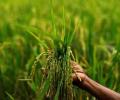
Riding high on the hopes of a normal monsoon, the agriculture ministry aims to increase foodgrain production by 6.35 million tonnes to a record 298.3 million tonnes in the 2020-21 crop year. The foodgrain output in the 2019-20 crop year (July-June) is estimated at an all-time high 291.95 million tonnes, as per the second advance estimates released by the ministry in February.
"GDP at factor cost at constant (1999-2000) prices in the year 2007-08 is likely to attain a level of Rs 31,14,452 crore (Rs 31,144.52 billion) as against Rs 28,64,310 crore (Rs 28,643.1 billion) in 2006-07," according to the advance estimates of national income released by the government on Thursday.

In the coming few weeks, agriculture markets in North and Central India will be full of wheat, mustard, and chana - the three main rabi crops grown in these parts. Not only will the price trajectory of these determine the course of food inflation in the months to come, but it could also have a wider impact on the rural economy in the main growing states for these crops. Wheat and chana are largely grown in Madhya Pradesh (MP).

The World Bank has retained India's economic growth forecast for the current fiscal at 8.3 per cent as the recovery is yet to become broad-based. As per the first advanced estimates of the national income released by the National Statistical Office (NSO) last week, the economy is projected to grow at 9.2 per cent in 2021-22, surpassing pre-COVID level in actual terms, mainly on account of improved performance, especially in farm, mining and manufacturing sectors. "India's economy is expected to expand by 8.3 per cent in fiscal year 2021/22 (ending March 2022), unchanged from last June's forecast as the recovery is yet to become broad-based.
India's growth slowed in three months through December from a revised 7.4% expansion in the previous quarter, but it was much stronger than expected.
Finance Minister P Chidambaram's speech.

The Survey presented by the Union Finance Minister, Shri Pranab Mukherjee in the Parliament on Friday states that the Indian economy remains the second fastest growing in the services growth with 8.9 per cent rate, behind China (10.5 per cent).

Projecting acceleration in India's GDP growth to 9% for FY 2011-012, Economic Advisory Council to Prime Minister seeks measure to address serious supply bottlenecks.
The previous high was recorded at 7.5 per cent in the July-September quarter of 2016-17.

Fearing likely shortage, the government on Thursday said it has made an advance plan to import about 10 lakh tonne higher quality of tur dal via private trade this year to meet the domestic requirement. The issue was discussed in a high-level meeting called by the cabinet secretary to review the prices of essential commodities, especially pulses and onions. Tur production is pegged lower at 3.89 million tonne in the 2022-23 crop year (July-June) from 4.34 million tonne in the previous year as per the initial projection made by the agriculture ministry. Tur is a kharif crop.

One just hopes that the collections stay stable on Monday and Tuesday especially and the drop is at maximum in 30% to 40% range.

The banking system's liquidity slipped into deficit for the first time in the current financial year (2023-24) due to the imposition of the Incremental Cash Reserve Ratio (I-CRR) for banks and outflows from goods and services tax (GST) payments, according to dealers. Reserve Bank of India (RBI) data shows it injected Rs 23,644 crore on August 21. The last time liquidity was in deficit was on March 27, when the RBI injected Rs 45,575 crore.
HDFC Bank Q1FY24 results analysis: Shares of HDFC Bank, the world's seventh largest financial entity, have advanced 2 per cent in two days, as against 1 per cent rise in the benchmark S&P BSE Sensex, after the lender reported its April-June quarter (Q1) results for financial year 2023-24 (FY24) on July 17. The S&P BSE Bankex index, meanwhile, has gained 1.3 per cent. While the near-term stock performance may remain sideways due to merger-related hiccups, analysts remain bullish on the stock's long-term prospects.

For 2010-11, the country hopes to achieve a gross domestic product growth of 8.5 per cent (plus or minus of 0.25 per cent), the finance minister said.

Advance estimates of national income growth released today by the Central Statistical Organisation (CSO) project it at 7.2 per cent in 2009-10, pegging it a notch below earlier forecasts of the Reserve Bank of India (7.5 per cent) and finance ministry (7.75 per cent). With economic growth back on track the government may initiate a phased withdrawal of the fiscal stimulus package.

A few days back, Atul Ganatra, president of the Cotton Association of India, presented a grim scenario of the crop's prospects in the 2024-25 season that starts in October. Addressing the association's annual general meeting, Ganatra said the area under the crop could go down by at least 10 per cent in the coming season due to falling yields and realisation, leading to farmers losing interest. The fear of a decline in acreage comes against the backdrop of India's cotton production probably falling to its lowest in a decade, according to estimates.
The worst drought in a century and its cascading effect has led to a sharp fall in India's foodgrain output by 30 million tonne to a seven-year low of 182.57 million tonne in 2002-03.
With drought taking its toll, India's oilseeds production has fallen by a massive one-fourth to the lowest in more than 13 years at 157.5 lakh tonne from 208 lakh tonne, it was officially announced on Thursday.

According to the Central Statistical Organisation data, released earlier in the day, Index of Industrial Production grew by 16.7 per cent in January against just a per cent during the corresponding month in 2009.

No lives were lost after cyclone Biparjoy made landfall. Preparations for Biparjoy were not only extensive, they were also telecast far and wide. Ahead of the cyclone's landfall, Shyam G Menon observes there was considerable publicity on how much the government was geared up to face the storm and its aftermath.
The production of major agricultural crops is likely to drop by 12 per cent for 2002-03, reflecting an adverse impact of poor monsoon, according to the Centre for Monitoring Indian Economy.\n\n\n\n
Confirming fears of a slowdown, the growth rate of the economy is estimated to plunge to 4.4. per cent during 2002-03 as against 5.6 per cent during the previous fiscal.
Economist and former Reserve Bank Governor C Rangarajan on Monday said that the economy will recover in the second half of 2009 and there would be distinct improvement in growth in 2010-11.
Per capita income, according to advance estimates for national income released, is expected to grow by 14.4 per cent during the current fiscal, the highest growth rate recorded in a single year in the last decade. It is expected to soar by Rs 4,801 to Rs 38,084 during 2008-09, which means the per capita income has more than doubled in the last seven years.

Petrol doped with 20 per cent ethanol was rolled out on Monday at select petrol pumps in 11 states and union territories as part of a programme to increase use of biofuels to cut emissions as well as dependence on foreign exchange-draining imports. At present, 10 per cent ethanol is blended in petrol (10 per cent ethanol, 90 per cent petrol) and the government is looking to double this quantity by 2025. Prime Minister Narendra Modi launched the higher 20 per cent ethanol blended petrol two months ahead of the planned rollout in April, at the India Energy Week (IEW) 2023 in Bengaluru.
India's per capita income grew by 10.5 per cent to Rs 44,345 in 2009-10 against Rs 40,141 in the year-ago period, according to government data.
The monthly income of an average Indian for the first time in the country's history has crossed Rs 3,000, thanks to economic reforms and a high growth rate of above 9 per cent achieved for three years since 2005-06.The per capita income, a measure of average income of a citizen, went up 12.2 per cent to Rs 37,490 per annum during 2008-09, said the advance estimate for national income released by the Central Statistical Organisation (CSO) on Friday.
Showing no immediate signs of recovery, the American economy shrank at staggering rate of 6.1 per cent in the first three months of 2009, one of the worst contractions in decades.

A senior government functionary claimed on Thursday that the average estimated cost of MQ-9B long endurance drones for India would be 27 per cent lower than the price incurred by other countries which have bought it from the US, asserting that it will most likely go further down during negotiations unless India seeks additional features.
The Indian economy is projected to have grown at a slower pace in 2007-08, as data released today showed industrial production growth during the year moderated considerably over the previous year. The advance estimates for national income for 2007-08 had pegged the growth of gross domestic product at 8.7 per cent. Economists now expect it to be a notch lower.

Cultivate a thirst for knowledge, explore online courses, attend workshops and network with peers. Embrace opportunities to learn new skills and stay updated about industry trends to remain relevant and future-proof your career, advises Manu Saigal, director-general, staffing, Adecco India.
Karnataka has registered a lower rate of growth in its gross state domestic product (GSDP) compared to the national average in 2007-08. It logged a 7 per cent growth in its GSDP as against the national advance estimates of 8.7 per cent. Inflation was more or less the same as that of the country. The performance of secondary and tertiary sectors (comprising industry and services) has turned out to be a major disappointment unlike the agriculture sector, which has fared better.

India's Gross Domestic Product (GDP) is expected to expand by 9.2 per cent in the current financial year, according to the Economic Survey 2021-22 tabled in the parliament on Monday. "Advance estimates suggest that the Indian economy is expected to witness real GDP expansion of 9.2 per cent in 2021-22 after contracting in 2020-21. "This implies that overall economic activity has recovered past the pre-pandemic levels," Economic Survey noted. Almost all indicators show that the economic impact of the "second wave" in Q1 was much smaller than that experienced during the full lockdown phase in 2020-21 even though the health impact was more severe, it said.
 © 2026 Rediff.com - Advertise with us - Disclaimer - Privacy Policy - Sitemap - Feedback - About us - Terms of use - Grievances